
In today’s digital economy, your business network is the backbone of every operation. It connects employees, applications, data centers, cloud services, branch offices, and customers while ensuring critical business processes remain available around the clock.
As organizations expand, simple office networks quickly become inadequate. Modern enterprises require networking infrastructure that is secure, scalable, highly available, and capable of supporting increasing workloads without compromising performance.
Whether you’re a growing business establishing your first enterprise network or an established organization modernizing legacy infrastructure, understanding enterprise networking fundamentals is essential for long-term success.
This guide explores the key components, architecture, security principles, and best practices for building a reliable enterprise network.
What Is Enterprise Network Infrastructure?
Enterprise network infrastructure is the collection of hardware, software, communication technologies, and security systems that enable users, devices, applications, and cloud services to communicate across an organization.
Unlike residential networks, enterprise networks are designed to support:
- Thousands of connected devices
- High network availability
- Mission-critical applications
- Secure data transmission
- Centralized management
- Future business growth
A well-designed enterprise network serves as the foundation for digital transformation initiatives, cloud adoption, remote work, and business continuity.
Core Building Blocks of an Enterprise Network
Modern enterprise infrastructure typically consists of several interconnected networking environments.
Local Area Network (LAN)
The Local Area Network (LAN) connects users and devices within offices, campuses, or buildings.
LAN infrastructure typically supports:
- Desktop computers
- IP phones
- Printers
- Servers
- Wireless access points
- IoT devices
A high-performance LAN provides fast, low-latency communication across internal systems.
Wide Area Network (WAN)
A Wide Area Network (WAN) connects geographically dispersed locations, including:
- Branch offices
- Headquarters
- Data centers
- Remote employees
WAN technologies enable secure communication across cities, countries, or global operations.
Cloud Networking
Today’s enterprise infrastructure extends beyond physical offices.
Cloud networking securely integrates enterprise networks with cloud providers such as:
- Amazon Web Services (AWS)
- Microsoft Azure
- Google Cloud Platform (GCP)
Cloud connectivity enables organizations to deploy scalable applications, disaster recovery solutions, and hybrid cloud architectures.
Essential Components of Enterprise Networks
Every enterprise network relies on specialized networking equipment that works together to deliver reliable connectivity.
High-Performance Network Switches
Switches form the backbone of the Local Area Network.
Enterprise switches provide:
- High-speed Ethernet connectivity
- VLAN support
- Layer 2 and Layer 3 switching
- Quality of Service (QoS)
- Link aggregation
- Network redundancy
- Power over Ethernet (PoE)
Managed switches offer centralized configuration, monitoring, and security features that are essential for enterprise environments.
Enterprise Routers
Routers connect different networks and direct traffic efficiently between:
- Internal LANs
- Branch offices
- Data centers
- Internet connections
- Cloud platforms
Enterprise routers support advanced routing protocols such as:
- OSPF
- BGP
- IS-IS
- EIGRP (where applicable)
These protocols improve scalability and resilience across large networks.
Next-Generation Firewalls (NGFW)
Modern firewalls provide significantly more than traditional packet filtering.
Enterprise NGFW solutions include features such as:
- Deep packet inspection
- Application awareness
- Intrusion Prevention System (IPS)
- Malware protection
- URL filtering
- SSL/TLS inspection
- Threat intelligence integration
- VPN services
They form the first line of defense against evolving cyber threats.
Wireless Access Points (WAPs)
Wireless networking has become a critical component of enterprise infrastructure.
Modern Wi-Fi deployments support:
- Employee connectivity
- Guest access
- IoT devices
- Voice over Wi-Fi
- Mobile workforces
Enterprise-grade wireless access points provide centralized management, seamless roaming, and enhanced security.
Software-Defined WAN (SD-WAN)
Traditional WAN connectivity is increasingly being replaced by Software-Defined WAN (SD-WAN).
SD-WAN enables organizations to:
- Improve application performance
- Reduce WAN costs
- Simplify branch connectivity
- Optimize cloud access
- Increase network resilience
By intelligently routing traffic across multiple internet connections, SD-WAN improves both performance and reliability.
Best Practices for Building Reliable Business Infrastructure
Purchasing enterprise networking equipment alone does not guarantee reliability.
Proper architecture and operational planning are equally important.
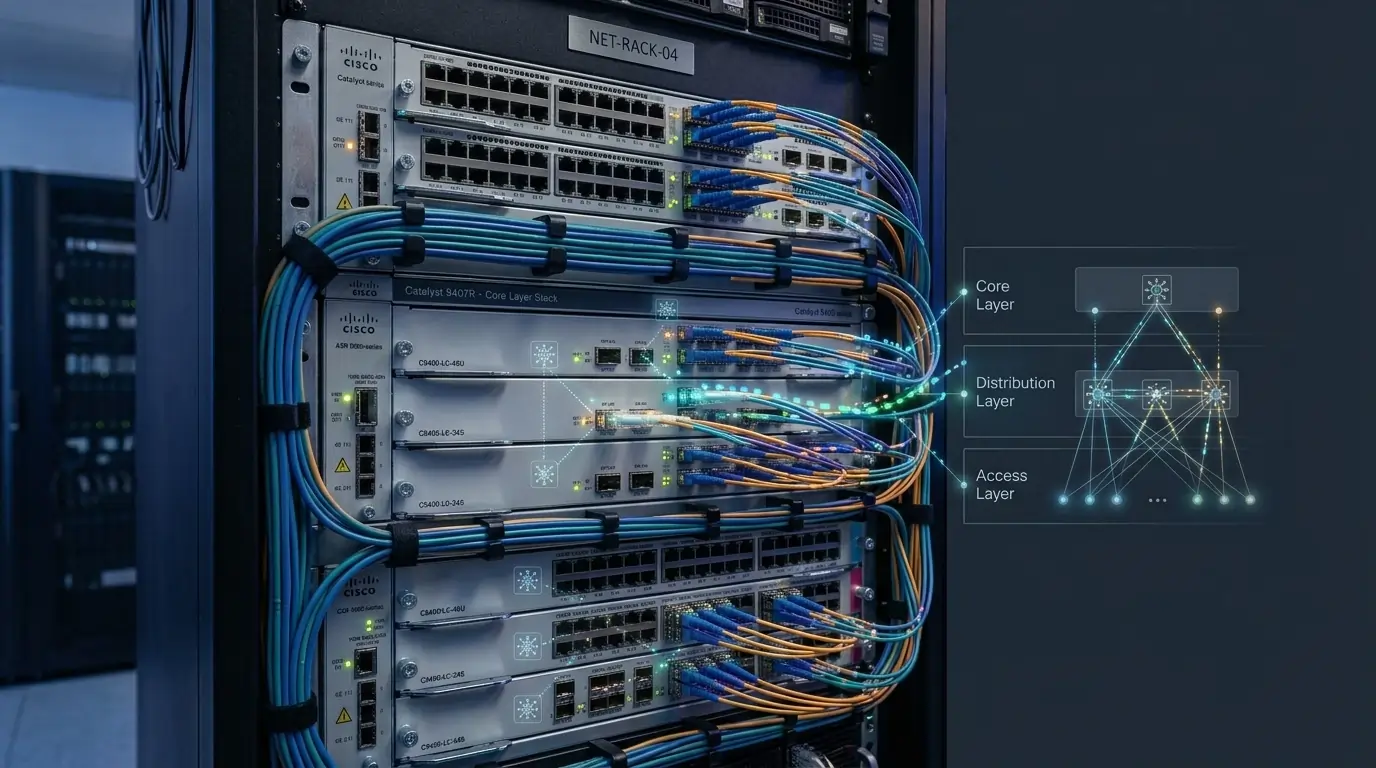
1. Implement a Hierarchical Network Design
Avoid connecting every device directly to a single switch.
Instead, adopt a three-tier hierarchical architecture consisting of:
Core Layer
The high-speed backbone responsible for transporting traffic across the enterprise.
Distribution Layer
Provides routing, policy enforcement, redundancy, and traffic aggregation.
Access Layer
Connects end-user devices, wireless access points, IP phones, and printers.
This modular design simplifies scalability, troubleshooting, and maintenance.
2. Design for High Availability
Business networks should continue operating even if hardware or network links fail.
High availability can be achieved through:
- Redundant switches
- Multiple routers
- Dual power supplies
- Link aggregation
- Dynamic routing protocols
- Redundant internet providers
- High Availability (HA) firewalls
Eliminating single points of failure significantly improves business continuity.
3. Segment Your Network
Network segmentation improves both performance and security.
Create separate network segments for:
- Finance
- Human Resources
- Engineering
- Servers
- Guests
- Voice systems
- IoT devices
Segmentation reduces broadcast traffic and limits the spread of cyberattacks.
Virtual LANs (VLANs) are commonly used to implement logical segmentation.
4. Prioritize Critical Applications
Not all network traffic is equally important.
Implement Quality of Service (QoS) to prioritize latency-sensitive applications such as:
- Video conferencing
- Voice over IP (VoIP)
- Business-critical applications
- ERP systems
- Real-time collaboration tools
QoS helps maintain a consistent user experience during periods of high network utilization.
Embedding Security into the Network Foundation
Security should be integrated into the network architecture rather than added later.
Modern enterprises increasingly adopt a Zero Trust security model.
Instead of automatically trusting devices inside the network, Zero Trust continuously verifies users, devices, and applications before granting access.
Implement 802.1X Network Authentication
Use IEEE 802.1X authentication to ensure that only authorized users and devices can access the network.
Benefits include:
- Identity-based access control
- Improved endpoint security
- Centralized authentication
- Reduced unauthorized access
Deploy Intrusion Prevention Systems (IPS)
Modern firewalls and dedicated IPS solutions monitor network traffic in real time to detect and block malicious activity.
IPS solutions help defend against:
- Malware
- Exploits
- Command-and-control traffic
- Network attacks
- Unauthorized access attempts
Secure the Management Plane
Protect administrative access to networking devices by:
- Restricting management interfaces
- Using secure protocols such as SSH and HTTPS
- Disabling Telnet and HTTP
- Implementing Multi-Factor Authentication (MFA)
- Applying role-based access control (RBAC)
Administrative interfaces should never be publicly accessible.
Network Automation and Monitoring
As enterprise environments grow, manual network management becomes increasingly difficult.
Automation improves consistency while reducing operational errors.
Infrastructure Automation
Automate repetitive tasks such as:
- Device provisioning
- Configuration deployment
- Backup management
- Firmware updates
- Compliance validation
Automation reduces configuration drift and improves operational efficiency.
Real-Time Network Monitoring
Continuous monitoring provides visibility into network health and performance.
Monitor metrics including:
- Bandwidth utilization
- Interface status
- Device availability
- Latency
- Packet loss
- CPU utilization
- Memory usage
- Network errors
Proactive monitoring helps identify issues before they impact users.
Popular Enterprise Network Management Tools
Many organizations use enterprise monitoring and management platforms such as:
- SolarWinds Network Performance Monitor
- PRTG Network Monitor
- Cisco DNA Center
- Juniper Mist
- Zabbix
- Nagios
- LibreNMS
These solutions provide centralized visibility, automation, and reporting across complex enterprise environments.
Planning for Future Growth
Enterprise networks should be designed with scalability in mind.
Plan for future expansion by considering:
- Additional branch offices
- Cloud adoption
- Remote workforce growth
- IoT deployments
- Increased wireless capacity
- Higher bandwidth requirements
- Business continuity planning
A scalable architecture reduces future upgrade costs and minimizes operational disruption.
Additional Enterprise Networking Best Practices
To build a resilient business network:
- Document network architecture thoroughly.
- Implement regular configuration backups.
- Keep firmware and operating systems updated.
- Perform routine vulnerability assessments.
- Conduct periodic network performance audits.
- Use centralized identity management.
- Monitor network logs continuously.
- Encrypt sensitive communications.
- Test disaster recovery procedures regularly.
- Review security policies periodically.
Conclusion
Enterprise networking forms the foundation of every modern organization.
By implementing:
- Scalable network architecture
- High-performance switching and routing
- Next-Generation Firewalls
- SD-WAN connectivity
- Cloud networking integration
- High availability
- Network segmentation
- Zero Trust security
- Automation
- Continuous monitoring
organizations can build secure, reliable, and future-ready infrastructure capable of supporting business growth and digital transformation.
Investing in enterprise networking today ensures better performance, stronger cybersecurity, and improved operational efficiency for years to come.
Frequently Asked Questions
What is enterprise networking?
Enterprise networking is the design and management of large-scale business networks that securely connect users, devices, applications, branch offices, data centers, and cloud services.
What is the difference between LAN and WAN?
A LAN connects devices within a single location, such as an office or campus, while a WAN connects multiple locations over larger geographic areas.
Why is SD-WAN important?
SD-WAN improves network performance, reduces connectivity costs, enhances cloud access, and provides intelligent traffic routing across multiple internet connections.
What is Zero Trust Networking?
Zero Trust is a security model that requires continuous verification of every user, device, and application before granting network access, regardless of location.
Why is network segmentation important?
Segmentation improves security by isolating departments, applications, and devices, reducing both broadcast traffic and the impact of cyberattacks.